What if sludge from wastewater treatment could be used to produce a valuable raw material instead of being incinerated?
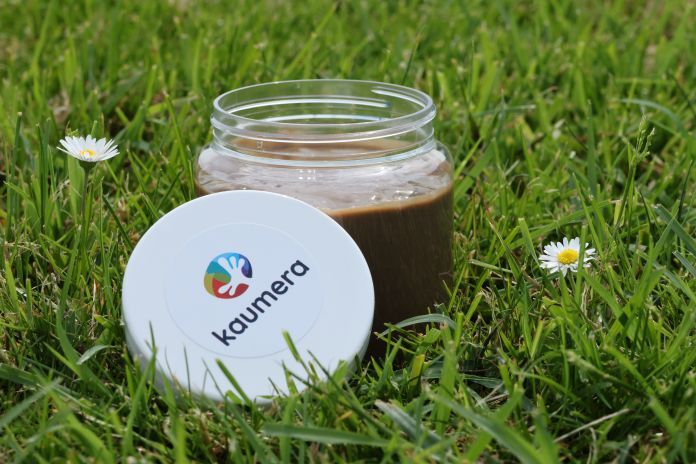
This question lies at the heart of Kaumera, a biobased polymer recovered from wastewater treatment. What started as a scientific discovery in the Netherlands has evolved into an opportunity to rethink how we source materials, develop products and work together across industries.
Our ambition is clear: to help replace conventional fossil-based ingredients with a circular, biobased alternative and contribute to reducing the carbon footprint of various industries.
But discovering and producing a new raw material is only the beginning. Putting this into practice requires something equally important: partners willing to explore the possibilities together and then incorporate it into their materials.
From scientific discovery to industrial reality
The story of Kaumera began with research into Nereda® wastewater treatment technology. Researchers discovered that the aerobic granular sludge formed during this process contained valuable natural polymers that could be recovered. These extracellular polymeric substances, or EPS, form the basis of Kaumera.
In 2019, the world’s first Kaumera extraction facility opened in Zutphen, the Netherlands, followed by a second facility in Epe in 2020. These milestones demonstrated that recovering a biobased raw material from wastewater was technically possible at industrial scale.
Yet producing a new material does not automatically create a market for it. The next challenge is translating its properties into practical value within industrial products and processes.
Kaumera is not a drop-in solution
One of the most important things to understand about Kaumera is that it is (in most cases) not a drop-in solution.
Introducing it into a formulation is not simply a matter of replacing an existing ingredient and expecting everything else to remain the same. It can require adjustments to a formulation or processing conditions.
Among other applications, Kaumera can improve soil life and serve as a binder in industrial formulations, such as panel boards. Identifying where these characteristics offer a meaningful advantage takes testing, application knowledge and a clear understanding of the intended product.
Circularity and biobased origins provide a reason to investigate. Functional performance, reliability and commercial feasibility determine whether an application can succeed.
Combining knowledge of product and industry is the key
At Kaumera Sales & Services, we bring the material and our knowledge of EPS: its properties, behaviour and potential functions. Industrial partners bring detailed knowledge of their own products, formulations, manufacturing processes and customer requirements.
By jointly testing formulations, sharing results and discussing what needs to change, we can identify where Kaumera fits and what is needed to make it work. Not every trial will deliver the desired result. Some applications will require further development, while others may prove unsuitable. Honest feedback and shared learning are therefore essential.
This journey requires commitment, flexibility and a willingness to reconsider established approaches. Above all, it requires partners who share the motivation to make their products more sustainable and are prepared to invest in that ambition.
Why meeting the right people matters
Events such as Bio Innovations help to find people with the same mindset and create the connections that are necessary to make this world a better place.
They bring together people with a shared motivation to make industry more sustainable, providing opportunities to exchange knowledge, discuss challenges openly and find partners with complementary expertise.
For a material such as Kaumera, these conversations are crucial. Successful collaboration starts with a shared goal and a willingness to go off the beaten path to reduce CO2 emissions.
Turning a circular, biobased raw material into a successful ingredient takes trust, dedication and sustained cooperation. Events that connect people around this ambition help tremendously.
An invitation to develop together
We kindly invite industrial partners to explore Kaumera with us as a biobased alternative in their formulations. Together, we can investigate what works, identify the changes needed and assess the potential to reduce your product’s carbon footprint.
Bringing Kaumera to market is a shared journey. Its success depends on people who are willing to combine their knowledge, adapt their approach and work together to replace synthetic ingredients in formulations to reduce the CO2 footprint.
Auteur: Patrick van der Velden, Managing director Kaumera Sales & Services B.V.