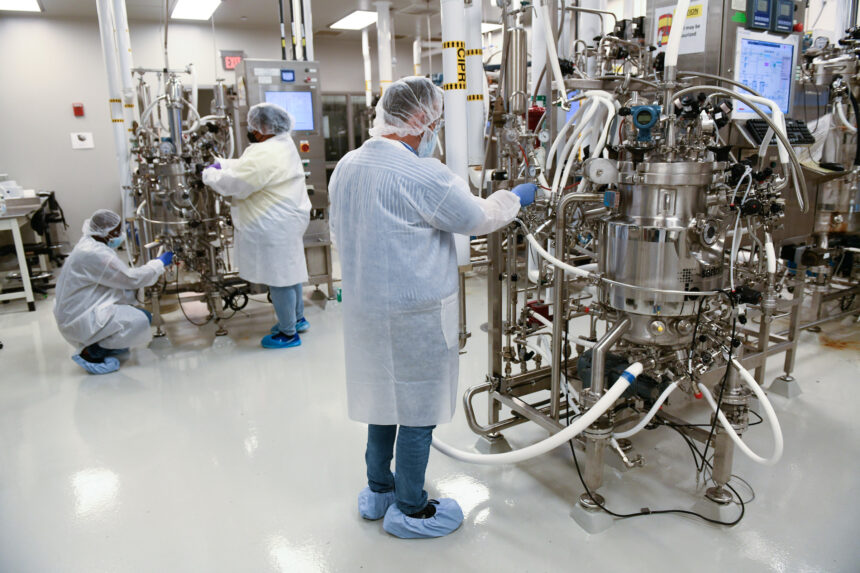
Major chemical companies in China are entering biomanufacturing, driving down the costs of sustainable materials.
We profile three Chinese companies that show how the country’s bioeconomy is rapidly shifting from startups to scale-up.
A history of scale
China has mastered industrial scaling in key sectors over the last 40 years, led by the goal of becoming a globally competitive export economy.
In 2015, China’s government shifted strategy, vowing to move away from the low-tech industry that dominated the country’s economy. The new national policy was to master more sophisticated manufacturing processes in sectors like computing, renewables, advanced materials, and specialty chemicals.
Ten years on, its industrial policy has paid dividends. In 2022, the country represented 44% of global chemical production and 46% of capital investment, making it the biggest global player in the space. Specialty chemicals in particular have boomed.

The last 5 years have seen particularly intense expansion, with Chinese chemical production now so large it could meet a significant slice of global demand.
Chinese biochemicals are no exception to this growth trend. China already produces more of the bioplastic PLA than it can consume, with major producers like Kingfa still expanding. China is also the leading global producer and exporter of PBAT, which makes up 30% of the global biodegradable plastic produced in the world in 2021.
The Yangtze River Delta (YRD), with hubs like Shanghai, Jiangsu, Zhejiang, and Anhui, concentrates China’s leading synthetic biology and biomanufacturing industries.
The Chinese biomanufacturing sector is also about to get a lot bigger. According to CEC Capital Group’s projections, China’s bio-manufacturing market is expected to reach 2 trillion yuan (279 billion U.S. dollars) by 2033, a 16.6.% compound annual growth rate.
A lot of this growth will come from major investments by existing chemical companies that have already achieved scale in petrochemicals. Having cut their teeth in the legacy chemicals sector, they are now transferring capital and know-how to renewable materials.
Kingfa
Kingfa is a typical Chinese biomanufacturing heavyweight. Founded in 1993, its niche has been in specialty materials: engineering plastics, carbon fibre, composite materials, hydrogen energy, and high performance resins, as well as polymers for medical applications. It also recycles plastics.
On top of synthetic chemicals, Kingfa is growing its biobased offering. It is already among the world’s biggest bioplastic producers, making 274, 000 tonnes of biobased plastics in 2024.
At the start of 2025, it completed its 10, 000 tonne annual capacity bio-based 1,4-butanediol (succinic acid) plant in Liaoning province, China. The plant makes the chemical using a bio-fermentation process, a departure from traditional methods that use petroleum-based ingredients.
As with the other Chinese green chemical giants, R&D is an important component of its work. In 2024 it signed a “Green Biomanufacturing Strategic Cooperation” with Beijing University of Chemical Technology in 2024, saying the partnership aims to reduce emissions through green manufacturing and by transforming the petrochemical industries.
Kingfa is now expanding to new markets to sustain its growth. This year, it began construction on its largest European facility to date in western Poland. The site in Poland will have productive capacity but also an R&D section to develop EU-compliant technologies in biodegradable materials and chemical recycling.
2025 was also the year that Kingfa broke ground on its new plant in Mexico. It already has a European facility in Wiesbaden, Germany. Its European and South American sites come in addition to a long-term presence in India.
Wanhua
Wanhua is one of the largest chemical producers in the world, known for its dominance in the Methylene diphenyl diisocyanate market. The chemical is a precursor for rigid polyurethane. It also develops and manufactures petrochemicals and performance chemicals.
Though most of Wanhua’s revenue still derives from synthetic chemicals, the company is now investing in biochemicals and biomaterials – what the company calls ‘emerging materials’. It set up a new biobased innovation R&D platform to develop these renewable alternatives.
In 2022, the company announced it had developed a bio-based thermoplastic polyurethane (TPU) product, building on its success in the fossil polyurethane supply chain. Its TPU has a biological content of up to 98%, with ingredients such as corn straw, and additives such as rice bran wax, as well as non-food corn and sesame.
TPU has applications in automotives, wires, cables, sports equipment, and in textile coatings, making it just the sort of multi-functional, multi-sectoral material that chemical producers target to maximise returns.
Wanhua Chemical also makes the biodegradable biomaterials PBAT, PLA, and PBS resin under the brand name Waneco. The range includes Waneco®T18 for agricultural mulch, designed to be buried after use, just like ordinary organic waste.
Wanhua’s ten production sites are based mostly in China but also in Hungary and the Czech Republic. R&D sites also extend across China, as well as Spain and Hungary. These international expansions are key to company strategy. The Spanish site opens doors to researchers and markets in both Europe and North Africa. At the same time, Spain’s cultural ties with South America marks a path towards another key growth market.
Sinopec
State-owned Sinopec has developed the most diverse range of biobased chemicals of the companies profiled here. Its product range extends from bioenergy (biojet fuel, biomethane) to biomaterials, including film for covering agricultural land and packaging materials such as biobased polypropylene.
Sinopec’s independently-developed PBST Biodegradable film targets microplastic pollution in farming. Plastic sheets used in agriculture are a huge source of pollution globally. China is the world’s biggest user of the material and suffers most from the problem.
This year, Sinopec tested its PBST mulch plastic in a pilot test in Wusu, Xinjiang. It achieved a cotton yield equal to that of fields where traditional plastic mulch was used, suggesting no loss in performance between the fossil plastic and Sinopec’s biobased material.
The company is active in bioenergy too. Germany’s BASF recently signed an agreement to get biomethane from Sinopec subsidiary Sinopec Tianranqi Company for BASF’s Nanjing chemical site. The partnership is designed to lower the carbon footprint of the products made there, ready for compliance with foreign markets.
Sinopec remains heavily embedded in the upstream of the fossil supply chain, being the largest oil and petrochemical products supplier in China. It is involved in petroleum and natural gas exploration and production. At the same time, it is investing in renewables, including in solar, wind, and biomass. It is aiming to become China’s biggest hydrogen producer.
Beijing supports scale
The government has signalled it is about to ramp up support for scaling biomaterials and biochemicals. While traditionally China’s biotech policy has focused on healthcare and genomics, policy emphasis on biomanufacturing and industrial green chemicals has been growing since 2022.
In November 2025, Beijing announced it would build scaling infrastructure for biopharma, food additives, enzymes, and cosmetics. The government has not yet specified how many test facilities it will build as part of the programmes. It has however published a list of 43 companies it has selected to build the test facilities, with the largest share from the food additives industry, followed by biopharma and biomanufacturing.
In 2023, China’s largest investment holding company, the State Development and Investment Corporation (SDIC), was tasked to lead public investment into biomanufacturing. The SDIC launched the Biomanufacturing Innovation Academy in Tianjin in December 2024. The institution has RMB 6 billion ($848 million) to commercialise enzymes, amino acids, food additives, and functional sugars.
Scale is not the only distinguishing mark of the Chinese chemical industry. Increasingly, the country is challenging the US on innovation too. In 2023, China was the top country for most-cited papers in synthetic biology (61% of global share) and biological manufacturing (29 %). The country has poured an estimated minimum of CNY 20 billion (EUR 2.6 billion) into public research in that year alone.
Analysts expect the government will soon formally back the biomanufacturing sector as a major new source of economic growth. The country has already conquered EVs, batteries, and nuclear power, in some cases to the extent of saturating global markets. Now, Beijing wants to achieve the same clout in chemicals and biopharmaceuticals, sectors where Chinese companies are globally competitive but not yet dominant.
Competitive advantages
The Chinese companies now throwing their weight behind biomanufacturing share certain features.
All began in specialty synthetic chemicals, achieving market dominance in key industrial molecules. Although they maintain their presence in synthetics, they are rapidly diversifying into green chemicals as global demand grows.
As established industrial producers, they have the requisite capital and talent to develop, test, scale, and market new materials.
Further, their size gives them the ability to vertically integrate operations: many have in-house R&D units, including in renewable materials, and the facilities to pull their own innovations out from the lab and into the market. This self-sufficient structure cuts costs and helps keep product prices down.
An opportunity for the world
With Chinese biomanufacturers expanding production facilities abroad, other regions could now profit from their advances.
With the right tech transfer deals, countries where Chinese companies are expanding could ensure access to the latest production methods and manufacturing processes they are bringing.
Such deals could become an important way for the rest of the world to build their own manufacturing industries using Chinese IP for producing sustainable materials at scale.